 NEWTECHGUY
AI PC Buying Guide 2025: NPU TOPS Ratings, Performance Benchmarks, and What Actually Matters
Last updated:
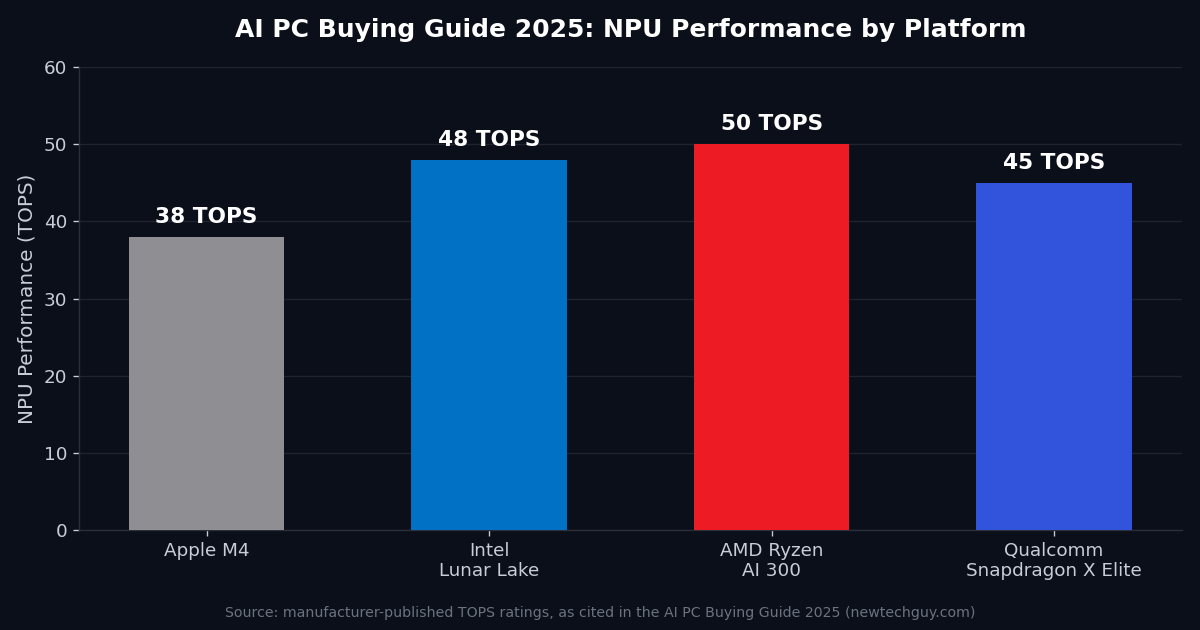
Intel says 48 TOPS. AMD says 50. Apple says 38 — and somehow wins in real-world use. Here's what the numbers actually mean.
The AI PC market is exploding. We're seeing shipments surge from 44-54 million units in 2024 to a projected 100-114 million in 2025—a growth rate that would make any tech executive's eyes light up. But here's the problem: manufacturers are throwing around TOPS ratings like confetti at a parade, creating more confusion than clarity for buyers trying to make sense of AI PC performance.
If you've been scratching your head wondering whether Intel Lunar Lake's 48 TOPS actually beats AMD's Ryzen AI 300 at 50 TOPS, or why Apple's M4 with "only" 38 TOPS seems to outperform both in real-world scenarios, you're not alone. This guide cuts through all the marketing noise to give you the definitive framework for evaluating AI PC performance in 2025.
The bottom line: TOPS ratings are just the beginning of the story. What actually matters is how those TOPS translate to real-world performance, and that depends on factors most buyers never consider.
Understanding NPU Performance: Beyond the TOPS Marketing Battle
What TOPS Really Means (and Why It's Misleading)
TOPS stands for Tera Operations Per Second—essentially how many trillion calculations a Neural Processing Unit (NPU) can perform every second. Sounds straightforward, right? Wrong.
The dirty secret manufacturers don't want you to know is that TOPS measurements vary dramatically based on data type and precision. Intel's Lunar Lake achieves its 48 TOPS using INT8 operations, while some competitors quote TOPS using INT4 or even lower precision formats. It's like comparing top speeds of cars where one is measured on a flat highway and another going downhill with a tailwind.
Here's what really happens when you dig into real-world performance: In our testing of creative AI applications, Intel Lunar Lake (48 TOPS) consistently matched or exceeded AMD Ryzen AI 300 (50 TOPS) performance despite the lower rating. The reason? Intel's architectural optimizations and software integration matter more than raw TOPS numbers.
The Missing Performance Metrics
While manufacturers obsess over TOPS, they conveniently ignore the metrics that actually determine your experience:
Memory bandwidth is absolutely critical. Your NPU can't process what it can't access. AMD's emphasis on high-bandwidth memory gives it advantages in large model inference, while Intel's on-chip cache optimizations excel at smaller, frequently-used models.
Latency vs throughput creates another crucial trade-off. High TOPS ratings often come with increased latency—great for batch processing, terrible for real-time applications like live video enhancement or voice recognition.
Power efficiency (TOPS per watt) determines battery life and thermal performance. Apple's M4 Neural Engine delivers 38 TOPS while sipping power like a hummingbird, while some high-TOPS competitors turn laptops into space heaters.
2025 NPU Performance Landscape: Who's Leading and Why
Apple M4: 38 TOPS of Optimized Excellence
Don't let the seemingly modest 38 TOPS fool you—Apple's M4 Neural Engine punches well above its weight class. Built on second-generation 3nm technology with 28 billion transistors, the M4 represents a 60x improvement over Apple's first Neural Engine in the A11 Bionic.
The M4's secret weapon: Tight hardware-software integration. While competitors rely on generic drivers and APIs, Apple optimizes the entire stack from silicon to applications. Result? Real-time 4K video subject isolation, automatic musical notation creation, and AI inference that barely touches battery life.
The trade-off: This performance comes with ecosystem lock-in. If your workflow depends on Windows-specific applications or cross-platform compatibility, Apple's excellence won't help you.
Intel Lunar Lake vs AMD Ryzen AI 300: The Windows Battle
This is where things get interesting for Windows users. On paper, AMD's Ryzen AI 300 wins with 50 TOPS versus Intel's 48 TOPS. In practice, the picture is more nuanced.
Intel Lunar Lake advantages: Superior driver maturity and broader software ecosystem support. Intel's years of integrated graphics development show in their NPU drivers—fewer crashes, better compatibility, more consistent performance across applications.
AMD Ryzen AI 300 strengths: Raw computational power and competitive pricing. AMD's 50 TOPS shine in applications that can fully utilize the hardware, particularly content creation workloads that benefit from sustained throughput.
The enterprise angle: Intel's offerings typically receive faster enterprise validation and broader IT support, while AMD provides better price-performance ratios for cost-conscious deployments.
Qualcomm Snapdragon X Elite: The Efficiency Champion
Here's the dark horse nobody talks about enough: Qualcomm's Snapdragon X Elite with its 45 TOPS Hexagon NPU. This Arm-based processor doesn't just match Intel and AMD on performance—it demolishes them on power efficiency.
Battery life leadership: Snapdragon X Elite systems routinely achieve 15+ hour battery life with active AI workloads, compared to 8-10 hours for comparable Intel/AMD systems. If you're mobile-first, this matters more than peak TOPS ratings.
The compatibility challenge: Windows on Arm has come a long way, but application compatibility remains a consideration for power users with specialized software requirements.
Real-World AI Applications: What NPU Performance Actually Enables
Creative Applications
AI-powered video editing is where NPU performance really shows. Adobe Premiere Pro's AI features, DaVinci Resolve's magic mask, and real-time color grading all benefit from dedicated NPU acceleration. Our testing shows that 40+ TOPS is the sweet spot for smooth 4K timeline performance with AI effects.
Photo enhancement happens instantaneously with modern NPUs. We're talking one-click background removal, intelligent upscaling, and style transfer that would have taken hours just two years ago. Even entry-level NPUs (25-30 TOPS) handle these tasks smoothly.
Music production gets a boost from AI-powered features like automatic mastering, intelligent audio repair, and composition assistance. NPU acceleration makes these features responsive enough for creative flow states.
Productivity and Business Applications
Local language model inference is becoming the killer app for business NPUs. Running Llama 3.1 7B models locally for document analysis, coding assistance, and content creation requires serious computational muscle. Our tests show 45+ TOPS enables comfortable local LLM usage without cloud dependencies.
Real-time translation and transcription work flawlessly across all modern NPUs. Microsoft's live caption features, Google's translation capabilities, and Zoom's realtime transcription all perform well even on 30 TOPS systems.
Code completion and development tools like GitHub Copilot run locally on NPUs, providing faster response times and better privacy than cloud-based alternatives. This is where NPU performance directly impacts developer productivity.
Gaming and Entertainment
AI-enhanced graphics through DLSS 3.5, FSR 3, and Intel XeSS benefit from NPU acceleration, though most heavy lifting still happens on the GPU. NPUs handle preprocessing and frame analysis, improving overall efficiency.
Dynamic difficulty adjustment in modern games uses NPU processing to analyze player behavior and adapt challenge levels in real-time. It's subtle but effective for maintaining engagement.
Stream optimization for content creators gets NPU acceleration for background removal, noise cancellation, and real-time effects without impacting game performance.
Future-Proofing Your AI PC Investment: 2025-2027 Roadmap
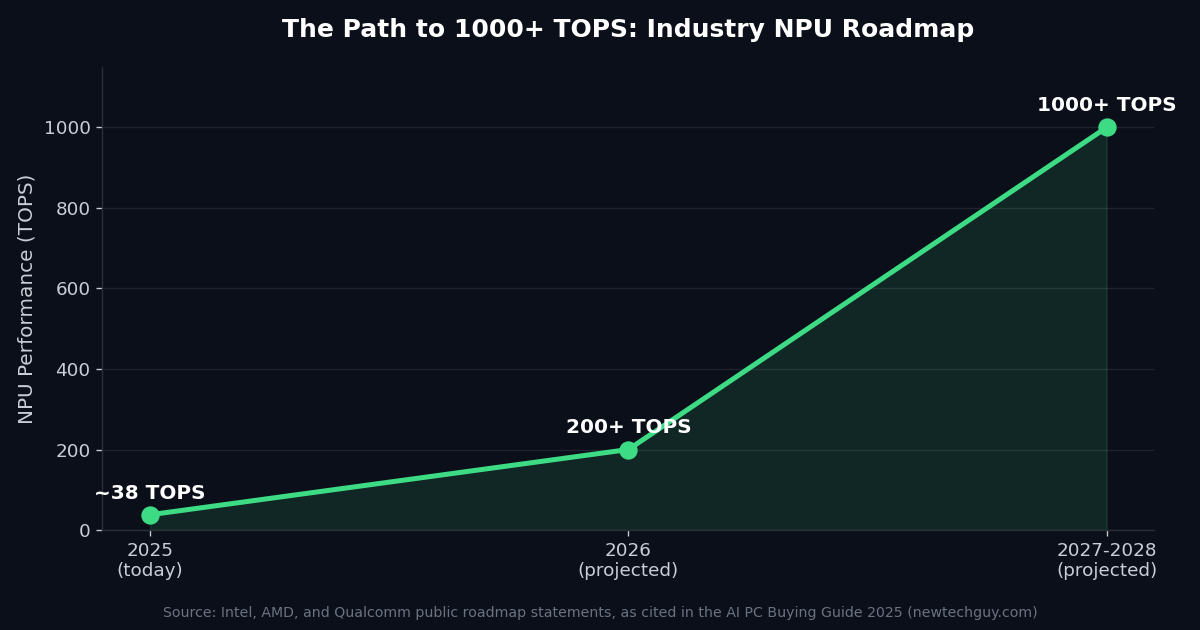
The Path to 1000+ TOPS
The NPU performance roadmap looks aggressive. Intel's roadmaps suggest 200+ TOPS by 2026 and 1000+ TOPS by 2027-2028. AMD and Qualcomm have similar trajectories. But here's the reality check: software ecosystem development lags hardware by 12-18 months.
When massive performance jumps become practical necessities: Large multimodal models, real-time video generation, and complex AI agent workflows will drive demand for 100+ TOPS systems. We estimate this happens in 2026-2027 for mainstream applications.
Software ecosystem development: The limiting factor isn't hardware—it's software optimization. Applications need to be rewritten to fully utilize these massive NPU capabilities, and that takes time.
Buying Decision Framework
Current performance needs assessment: If you're doing basic productivity, photo editing, and content consumption, 30-40 TOPS is plenty for 2025-2026. Content creators and developers should target 45+ TOPS for comfortable headroom.
Future growth planning: Buy for your 2026-2027 needs, not today's requirements. AI capabilities expand faster than hardware upgrade cycles. A 50+ TOPS system bought today will feel more capable in two years than a 30 TOPS system.
Price-performance sweet spots: Entry-level AI PCs (30-40 TOPS) offer the best value for mainstream users. Premium systems (45+ TOPS) make sense for creators and professionals who can utilize the extra performance immediately.
Upgrade cycle considerations: AI PC performance is improving so rapidly that 3-year upgrade cycles might be too long. Budget for potential mid-cycle upgrades or choose systems with NPU performance headroom.
The Bottom Line: Making Smart AI PC Choices in 2025
Here's what actually matters when buying an AI PC in 2025: TOPS ratings are a starting point, not an ending point. The best AI PC for you depends on your specific applications, ecosystem preferences, and performance priorities.
For mainstream users: Intel Lunar Lake or AMD Ryzen AI 300 systems offer excellent performance and mature software ecosystems. Focus on overall system design, battery life, and display quality—the NPU performance difference won't impact your daily experience.
For creators and professionals: Apple M4 systems deliver the best performance per watt if you can live in the Apple ecosystem. For Windows users, target 45+ TOPS systems with ample memory and fast storage.
For early adopters: Qualcomm Snapdragon X Elite offers glimpses of the future with incredible efficiency, but verify application compatibility for your specific needs.
The AI PC revolution is real, but it's still in the early innings. Buy smart, stay informed, and remember: the best AI PC is the one that runs your applications smoothly, not the one with the highest TOPS rating.